Can Bioplastics Work on the Farm? A Conversation with Professor Carol Miles
By Olivebio
When we think about plastic pollution, we often picture grocery bags or food packaging, but farming uses a surprising amount of single-use plastic. Plastic mulch films, plant ties, nursery labels, and irrigation supplies are just some of the everyday tools used in agriculture. They help farmers grow better crops, but most of these items end up in landfills—or worse, stay behind in the field.
I spoke with Professor Carol Miles, a horticulturalist at Washington State University who has spent over 25 years studying biodegradable mulch films. We talked about how bioplastics are used in agriculture today, why adoption has been slow, and where materials like PHA might fit into the future of farming.
Q: Prof. Miles, you’ve been working on biodegradable plastics in agriculture for quite a while. Can you tell us how you got into this space?
Prof. Miles: I’m a horticulturalist and plant breeder by training. Here at Washington State University, I run vegetable crop field trials. I mostly work with new emerging crops and our field trials typically focus around plant genetics and the suitability of specific crops for specific climates. Here, in the Northwestern US, we have what I would call a cool Mediterranean climate and we use plastic mulch quite a bit because it warms the soil, conserves moisture, and helps with weed control. It is a very useful tool for production.
Around 25 years ago, I decided to start looking into biodegradable plastic mulch options. I was working on organic farming systems and I had a moment where I thought, “Wait, this doesn’t make sense.” We use this plastic mulch, then remove it and send it to the landfill. That just didn’t feel compatible with sustainability and what growing organic crops should be like.
So I started exploring biodegradable plastic mulches. And back then, there weren’t many options – and frankly, a lot of what was on the market wasn’t what it claimed to be. Mislabeling and misinformation were rampant, and unfortunately, that hasn’t gone away completely. What we needed was soil degradable mulch film, not necessarily recyclable or industrially compostable film, because you really just want to till the film into the soil at the end of the growth cycle and have it degrade. Picking it up and throwing it into the compost or recycling bin costs extra money. Recycling is also not an option because the film is not clean after use – its weight upon removal can be up to 80% soil and plant debris. This adds a lot to the transport cost.
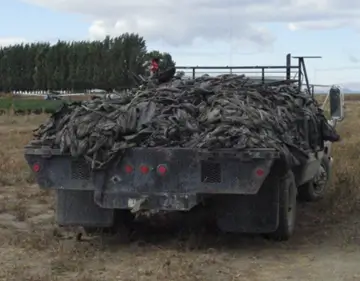
Typical post-season polyethylene (PE) mulch waste ready for transport to the landfill. (Photo by Prof. C. Miles)
Q: You mentioned working in organic farming as your trigger to look at biodegradable mulch films. It’s wild that conventional plastic mulch is allowed in organic farming, but biodegradable mulch still isn’t. Why is that?
Prof. Miles: It’s politics, honestly. The USDA’s organic standards require biodegradable mulch to be 100% bio-based and made without GMOs. That rules out most products. It’s frustrating – you end up in a situation where a plastic made from fossil fuels is allowed even though it creates a significant environmental burden, but a partially bio-based material or a material that is manufactured through genetically modified organisms isn’t. And it doesn’t matter that it is biodegradable.
Q: Outside of organic farming, when biodegradable mulch films are used, they still come at a premium compared to their non-biodegradable counterparts. How significant is that price difference as a barrier to broader adoption among farmers?
Prof. Miles: Cost is the barrier. Number one, two, and three. Even if biodegradable mulch saves money over the full season – by eliminating removal and disposal expenses – farmers tend to look only at upfront cost.
Q: What other barriers for adoption of biodegradable mulch films do you see?
Prof. Miles: One major barrier is simply awareness—most farmers still aren’t familiar with biodegradable mulch films. And for those who are, prior negative experiences can be a real deterrent. If a product labeled “biodegradable” didn’t break down as expected, they’re unlikely to try it again—and they’ll often share that experience with others. That’s why product performance is so critical, and why companies who make biodegradable mulch need to prioritize education and transparency.
There’s a tricky balance to strike: on the one hand, the film needs to degrade within the promised timeframe (with the caveat that degradation time can vary depending on the local climate); on the other, it must remain intact for the full duration of the crop’s growth cycle.
Another growing challenge is soil moisture retention. Mulch films are increasingly used to help preserve moisture in the soil—but if a biodegradable film does that job well, it may start degrading prematurely. Then there’s color. Different crops benefit from different mulch colors—black, white, green, reflective, and so on—but most biodegradable mulch manufacturers can’t yet meet those crop-specific color requirements.
So, you’re not just solving for biodegradability. You’re solving for performance across climates, crop cycles, moisture retention, and even color. It’s a complex set of demands.
Q: Beyond color, what are some other crop-dependent considerations for biodegradable mulch film manufacturers?
Prof. Miles: Speed of degradation. Most of my work is with vegetable crops, so the growth cycle is 4-5 months for those and the film needs to last that long. Strawberries are potentially a good target application for biodegradable mulch films. California strawberries have an 18-month growing cycle—longer than most vegetables, but much shorter than perennial crops like raspberries, which can go for seven years. So strawberries are a good middle ground. But for mulch to work there, it needs to stay intact for the full growth cycle. That’s challenging—and to get there, you usually have to increase film thickness, which drives up cost again. Additionally, in the case of strawberries, you have the fruit sitting on top of the film, so there are some food contact safety certifications that would be needed.
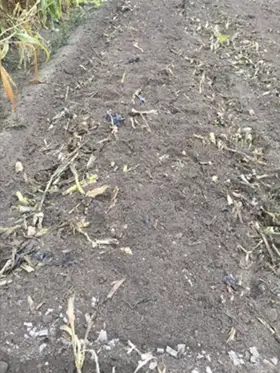
Fragments of soil biodegradable plastic mulch (BDM) are present on and in the soil, as expected, immediately after tillage (Photo by Prof. C. Miles).
Q: Agricultural mulch film, especially for those intermediate length growth cycle crops, sounds like the perfect application for polyhydroxyalkanoates (PHAs) - a class of biopolymers (bioplastics) that are non-toxic and degrade in soil and water rapidly without leaving microplastics behind. Do you think PHA could have a role to play in biodegradable mulch film applications, assuming the cost comes down?
Prof. Miles: Absolutely, some of my work has been with PHA containing mulch films. If the PHA containing film performs and is truly biodegradable in soil, it could be used across all current applications. In fact, our research suggests that materials like PHA might even improve soil microbial diversity because they act as a feedstock for microbes.
Q: That’s fascinating. From a soil health perspective, could increasing microbial diversity lead to better crops?
Prof. Miles: It can. A more diverse microbial community helps break down organic matter, making nutrients more available to plants. So in theory, yes—you could see benefits in nutrition and even growth. But we need more data before we can make strong claims there.
Q: Beyond mulch films, what other opportunities do you see for biodegradable plastics like PHA in agriculture—especially where soil biodegradability is a key advantage?
Prof. Miles: Plant ties are a big one. In vineyards and orchards, you use plastic tape to attach plants to trellises. At the end of the season, that tape gets cut and just drops to the ground—nobody is picking it up. Same with nursery labels, stakes, and even plastic twine. If it’s not biodegradable, it just stays in the field. It is too expensive to pay for workers to pick it up.
When we think about applications visible to the end consumer – what you and I see at the grocery store – produce labels and packaging are definitely good candidates for biodegradable plastics.
Q: Is there a specific standard that mulch films have to meet in the U.S.?
Prof. Miles: For soil biodegradability, the EU has a standard—EN 17033—but there’s no equivalent U.S. version yet. For compostable materials, the standard is ASTM D6400. But that only applies to industrial composting, and composting infrastructure is a whole other issue.
Q: So where does this leave us? What would you say to someone trying to bring a new biodegradable product to agriculture?
Prof. Miles: Start by making sure the product actually works in the field—and in the climate where you’re deploying it. One mulch might work well in California but not so well in Washington due to temperature differences. And above all, find a niche. Get a foothold with a specific crop or region, prove it works, and build from there. That’s the only way to make it stick.
Q: Final question—are you optimistic about the future of biodegradable plastics in agriculture?
Prof. Miles: I am. I really think they’re the future. We just have to find the right materials, test them properly, and build trust with farmers. It’s going to take time and persistence – but I believe it’s worth it.
Professor Carol Miles has diverse international experiences both growing up and in her early career where she has lived in subsistence agriculture communities in places such as Panama, Afghanistan, Cameroon, Malawi and Tanzania. Carol received her B.S. (1983) in Bio-Agricultural Science from Colorado State University, and her M.S. (1989) and Ph.D. (1993) in Vegetable Crops from the Department of Fruit and Vegetable Science at Cornell University. Carol’s goal has been to work with farmers to create sustainable production systems which provide a source of well-being to both the family and the community.




 TM
TM